| dc.contributor.author | Shirado, Hirokazu | |
| dc.contributor.author | Shimizu, Kye | |
| dc.contributor.author | Christakis, Nicholas | |
| dc.contributor.author | Kasahara, Shunichi | |
| dc.date.accessioned | 2025-09-18T20:16:16Z | |
| dc.date.available | 2025-09-18T20:16:16Z | |
| dc.date.issued | 2025-04-25 | |
| dc.identifier.isbn | 979-8-4007-1394-1 | |
| dc.identifier.uri | https://hdl.handle.net/1721.1/162756 | |
| dc.description | CHI ’25, Yokohama, Japan | en_US |
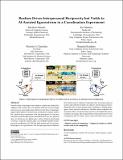
| dc.description.abstract | Virtual reality technologies that enhance realism and artificial intelligence (AI) systems that assist human behavior are increasingly interwoven in social applications. However, how these technologies might jointly influence interpersonal coordination remains unclear. We conducted an experiment with 240 participants in 120 pairs who interacted through remote-controlled robot cars in a physical space or virtual cars in a digital space, with or without autosteering assistance, using the chicken game, an established model of interpersonal coordination. We find that both realism and AI assistance help improve user performance but through opposing mechanisms. Real-world contexts enhanced communication, fostering reciprocal actions and collective benefits. In contrast, autosteering assistance diminished the need for interpersonal coordination, shifting participants’ focus towards self-interest. Notably, when combined, the egocentric effects of autosteering assistance outweighed the prosocial effects of realism. The design of HCI systems that involve social coordination will, we believe, need to take such effects into account. | en_US |
| dc.publisher | ACM|CHI Conference on Human Factors in Computing Systems | en_US |
| dc.relation.isversionof | https://doi.org/10.1145/3706598.3713371 | en_US |
| dc.rights | Creative Commons Attribution-Noncommercial | en_US |
| dc.rights.uri | http://creativecommons.org/licenses/by-nc/4.0/ | en_US |
| dc.source | Association for Computing Machinery | en_US |
| dc.title | Realism Drives Interpersonal Reciprocity but Yields to AI-Assisted Egocentrism in a Coordination Experiment | en_US |
| dc.type | Article | en_US |
| dc.identifier.citation | Hirokazu Shirado, Kye Shimizu, Nicholas A Christakis, and Shunichi Kasahara. 2025. Realism Drives Interpersonal Reciprocity but Yields to AI-Assisted Egocentrism in a Coordination Experiment. In Proceedings of the 2025 CHI Conference on Human Factors in Computing Systems (CHI '25). Association for Computing Machinery, New York, NY, USA, Article 693, 1–21. | en_US |
| dc.contributor.department | Massachusetts Institute of Technology. Media Laboratory | en_US |
| dc.identifier.mitlicense | PUBLISHER_POLICY | |
| dc.eprint.version | Final published version | en_US |
| dc.type.uri | http://purl.org/eprint/type/ConferencePaper | en_US |
| eprint.status | http://purl.org/eprint/status/NonPeerReviewed | en_US |
| dc.date.updated | 2025-08-01T08:07:20Z | |
| dc.language.rfc3066 | en | |
| dc.rights.holder | The author(s) | |
| dspace.date.submission | 2025-08-01T08:07:20Z | |
| mit.license | PUBLISHER_CC | |
| mit.metadata.status | Authority Work and Publication Information Needed | en_US |