| dc.contributor.author | Wheeler, Kelsey M. | |
| dc.contributor.author | Gold, Michaela A. | |
| dc.contributor.author | Stevens, Corey A. | |
| dc.contributor.author | Tedin, Karsten | |
| dc.contributor.author | Wood, Amanda M. | |
| dc.contributor.author | Uzun, Deniz | |
| dc.contributor.author | Cárcamo-Oyarce, Gerardo | |
| dc.contributor.author | Turner, Bradley S. | |
| dc.contributor.author | Fulde, Marcus | |
| dc.contributor.author | Song, Jeongmin | |
| dc.contributor.author | Kramer, Jessica R. | |
| dc.contributor.author | Ribbeck, Katharina | |
| dc.date.accessioned | 2025-09-26T19:37:35Z | |
| dc.date.available | 2025-09-26T19:37:35Z | |
| dc.date.issued | 2025-09-23 | |
| dc.identifier.issn | 2211-1247 | |
| dc.identifier.uri | https://hdl.handle.net/1721.1/162818 | |
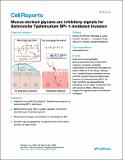
| dc.description.abstract | Mucus forms a critical barrier against enteric pathogens like Salmonella enterica serovar Typhimurium. While in vivo studies indicate that secreted, gel-forming mucins and specifically core 3 glycosylation are protective against S. Typhimurium, the molecular mechanisms involved remain unclear. Here, we demonstrate that native intestinal mucins inhibit Salmonella invasion of colonic epithelial cells by downregulating the type 3 secretion system through suppression of the key virulence regulator, HilD. Our study identifies mucin glycans and specific mucin sugars, namely N-acetyl galactosamine and N-acetyl glucosamine, as the components responsible for mucin’s anti-virulence effect, likely via functional or direct interaction with HilD’s putative carbohydrate-binding domain. Notably, we find that the native presentation of these sugars is important for activity. These insights provide a mechanistic foundation for mucin-based strategies to combat enteric infections and, given the prevalence of homologous AraC-type regulators in other pathogens, suggest mucins’ potential as broad-spectrum anti-virulence agents. | en_US |
| dc.publisher | Elsevier BV | en_US |
| dc.relation.isversionof | 10.1016/j.celrep.2025.116304 | en_US |
| dc.rights | Creative Commons Attribution | en_US |
| dc.rights.uri | https://creativecommons.org/licenses/by/4.0/ | en_US |
| dc.source | Elsevier BV | en_US |
| dc.title | Mucus-derived glycans are inhibitory signals for Salmonella Typhimurium SPI-1-mediated invasion | en_US |
| dc.type | Article | en_US |
| dc.identifier.citation | Mucus-derived glycans are inhibitory signals for Salmonella Typhimurium SPI-1-mediated invasion. Wheeler, Kelsey M. et al. Cell Reports, 116304. | en_US |
| dc.contributor.department | Massachusetts Institute of Technology. Department of Biological Engineering | en_US |
| dc.contributor.department | Massachusetts Institute of Technology. Microbiology Graduate Program | en_US |
| dc.relation.journal | Cell Reports | en_US |
| dc.eprint.version | Final published version | en_US |
| dc.type.uri | http://purl.org/eprint/type/JournalArticle | en_US |
| eprint.status | http://purl.org/eprint/status/PeerReviewed | en_US |
| dc.identifier.doi | https://doi.org/10.1016/j.celrep.2025.116304 | |
| dspace.date.submission | 2025-09-26T19:26:58Z | |
| mit.license | PUBLISHER_CC | |
| mit.metadata.status | Authority Work and Publication Information Needed | en_US |