| dc.contributor.author | Li, Yuqing Lucy | |
| dc.contributor.author | Kubu?ov?, Vlasta | |
| dc.contributor.author | Babatain, Wedyan | |
| dc.contributor.author | Labrune, Jean-Baptiste | |
| dc.contributor.author | Widder, Sage | |
| dc.contributor.author | Sun, Bernice | |
| dc.contributor.author | Forman, Jack | |
| dc.contributor.author | Ishii, Hiroshi | |
| dc.date.accessioned | 2025-10-06T20:53:41Z | |
| dc.date.available | 2025-10-06T20:53:41Z | |
| dc.date.issued | 2025-09-27 | |
| dc.identifier.isbn | 979-8-4007-2037-6 | |
| dc.identifier.uri | https://hdl.handle.net/1721.1/163064 | |
| dc.description | UIST ’25, Busan, Republic of Korea | en_US |
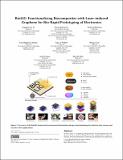
| dc.description.abstract | In HCI, there is a rapidly growing interest in prototyping with conductive bio-based materials. However, the methods for conductive making of bio-based materials to suit the diverse needs of makers remain underexplored. We introduce BioLIG, a fabrication framework that functionalizes affordable and optimized bio-based substrates with a conventional CO2 laser to create highly conductive traces for sensors and circuits. To illustrate the framework, we first contribute five bio-based materials: three sheets (paper-like, fabric-like, plastic-like) and two paints (lignin-ink, chitosan-stain). A formal electrical characterization of our conductors highlight that they surpass activated charcoal, are on par with carbon black, and one ink is even comparable with the most common synthetic material used for laser-induced graphene. Then, we present three biodegradable coatings that ensure functionality and durability and balance protection with controlled degradation. Next, we build upon our sheets, paints, and coatings to form multifunctional biodegradable biocomposites and implement five end-to-end applications. Lastly, we define three strategies of how the framework supports a circular making culture. BioLIG enables accessible, fast, and bio-rapid prototyping, adding new directions for designing sustainable electronics with environmental integration. | en_US |
| dc.publisher | ACM|The 38th Annual ACM Symposium on User Interface Software and Technology | en_US |
| dc.relation.isversionof | https://doi.org/10.1145/3746059.3747669 | en_US |
| dc.rights | Creative Commons Attribution-ShareAlike | en_US |
| dc.rights.uri | http://creativecommons.org/licenses/by-sa/4.0/ | en_US |
| dc.source | Association for Computing Machinery | en_US |
| dc.title | BioLIG: Functionalizing Biocomposites with Laser-induced Graphene for Bio-Rapid Prototyping of Electronics | en_US |
| dc.type | Article | en_US |
| dc.identifier.citation | Yuqing Lucy Li, Vlasta Kubušová, Wedyan Babatain, Jean-Baptiste Labrune, Sage A Widder, Bernice Sun, Jack Forman, and Hiroshi Ishii. 2025. BioLIG: Functionalizing Biocomposites with Laser-induced Graphene for Bio-Rapid Prototyping of Electronics. In Proceedings of the 38th Annual ACM Symposium on User Interface Software and Technology (UIST '25). Association for Computing Machinery, New York, NY, USA, Article 107, 1–18. | en_US |
| dc.contributor.department | Massachusetts Institute of Technology. Media Laboratory | en_US |
| dc.contributor.department | Massachusetts Institute of Technology. Center for Bits and Atoms | en_US |
| dc.identifier.mitlicense | PUBLISHER_POLICY | |
| dc.eprint.version | Final published version | en_US |
| dc.type.uri | http://purl.org/eprint/type/ConferencePaper | en_US |
| eprint.status | http://purl.org/eprint/status/NonPeerReviewed | en_US |
| dc.date.updated | 2025-10-01T07:53:26Z | |
| dc.language.rfc3066 | en | |
| dc.rights.holder | The author(s) | |
| dspace.date.submission | 2025-10-01T07:53:27Z | |
| mit.metadata.status | Authority Work and Publication Information Needed | en_US |