| dc.contributor.author | Zhu, Junyi | |
| dc.contributor.author | Xu, Tianyu | |
| dc.contributor.author | Wang, Jiayu | |
| dc.contributor.author | Guan, Emily | |
| dc.contributor.author | Moon, JaeYoung | |
| dc.contributor.author | Morvan, Stiven | |
| dc.contributor.author | Shin, D | |
| dc.contributor.author | Cola?o, Andrea | |
| dc.contributor.author | Mueller, Stefanie | |
| dc.contributor.author | Ahuja, Karan | |
| dc.contributor.author | Luo, Yiyue | |
| dc.contributor.author | Chatterjee, Ishan | |
| dc.date.accessioned | 2025-10-07T20:46:52Z | |
| dc.date.available | 2025-10-07T20:46:52Z | |
| dc.date.issued | 2025-09-28 | |
| dc.identifier.isbn | 979-8-4007-2037-6 | |
| dc.identifier.uri | https://hdl.handle.net/1721.1/163072 | |
| dc.description | UIST ’25, Busan, Republic of Korea | en_US |
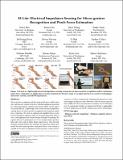
| dc.description.abstract | Micro-gesture recognition and fine-grain pinch press enables intuitive and discreet control of devices, offering significant potential for enhancing human-computer interaction (HCI). In this paper, we present EI-Lite, a lightweight wrist-worn electrical impedance sensing device for micro-gesture recognition and continuous pinch force estimation. We elicit an optimal and simplified device architecture through an ablation study on electrode placement with 13 users, and implement the elicited designs through 3D printing. We capture data on 15 participants on (1) six common micro-gestures (plus idle state) and (2) index finger pinch forces, then develop machine learning models that interpret the impedance signals generated by these micro-gestures and pinch forces. Our system is capable of accurate recognition of micro-gesture events (96.33% accuracy), as well as continuously estimating the pinch force of the index finger in physical units (Newton), with the mean-squared-error (MSE) of 0.3071 (or mean-force-variance of 0.55 Newtons) over 15 participants. Finally, we demonstrate EI-Lite’s applicability via three applications in AR/VR, gaming, and assistive technologies. | en_US |
| dc.publisher | ACM|The 38th Annual ACM Symposium on User Interface Software and Technology | en_US |
| dc.relation.isversionof | https://doi.org/10.1145/3746059.3747671 | en_US |
| dc.rights | Creative Commons Attribution | en_US |
| dc.rights.uri | https://creativecommons.org/licenses/by/4.0/ | en_US |
| dc.source | Association for Computing Machinery | en_US |
| dc.title | EI-Lite: Electrical Impedance Sensing for Micro-gesture Recognition and Pinch Force Estimation | en_US |
| dc.type | Article | en_US |
| dc.identifier.citation | Junyi Zhu, Tianyu Xu, Jiayu Wang, Emily Guan, JaeYoung Moon, Stiven Morvan, D Shin, Andrea Colaço, Stefanie Mueller, Karan Ahuja, Yiyue Luo, and Ishan Chatterjee. 2025. EI-Lite: Electrical Impedance Sensing for Micro-gesture Recognition and Pinch Force Estimation. In Proceedings of the 38th Annual ACM Symposium on User Interface Software and Technology (UIST '25). Association for Computing Machinery, New York, NY, USA, Article 23, 1–14. | en_US |
| dc.contributor.department | Lincoln Laboratory | en_US |
| dc.identifier.mitlicense | PUBLISHER_POLICY | |
| dc.eprint.version | Final published version | en_US |
| dc.type.uri | http://purl.org/eprint/type/ConferencePaper | en_US |
| eprint.status | http://purl.org/eprint/status/NonPeerReviewed | en_US |
| dc.date.updated | 2025-10-01T07:53:47Z | |
| dc.language.rfc3066 | en | |
| dc.rights.holder | The author(s) | |
| dspace.date.submission | 2025-10-01T07:53:48Z | |
| mit.license | PUBLISHER_CC | |
| mit.metadata.status | Authority Work and Publication Information Needed | en_US |