| dc.contributor.author | Han, Evans Xu | |
| dc.contributor.author | Zhang, Alice | |
| dc.contributor.author | Zhu, Haiyi | |
| dc.contributor.author | Shen, Hong | |
| dc.contributor.author | Liang, Paul Pu | |
| dc.contributor.author | Hsieh, Jane | |
| dc.date.accessioned | 2025-10-07T21:23:50Z | |
| dc.date.available | 2025-10-07T21:23:50Z | |
| dc.date.issued | 2025-09-27 | |
| dc.identifier.isbn | 979-8-4007-2037-6 | |
| dc.identifier.uri | https://hdl.handle.net/1721.1/163075 | |
| dc.description | UIST ’25, Busan, Republic of Korea | en_US |
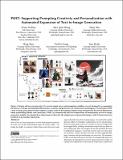
| dc.description.abstract | State-of-the-art visual generative AI tools hold immense potential to assist users in the early ideation stages of creative tasks — offering the ability to generate (rather than search for) novel and unprecedented (instead of existing) images of considerable quality that also adhere to boundless combinations of user specifications. However, many large-scale text-to-image systems are designed for broad applicability, yielding conventional output that may limit creative exploration. They also employ interaction methods that may be difficult for beginners. Given that creative end-users often operate in diverse, context-specific ways that are often unpredictable, more variation and personalization are necessary. We introduce POET, a real-time interactive tool that (1) automatically discovers dimensions of homogeneity in text-to-image generative models, (2) expands these dimensions to diversify the output space of generated images, and (3) learns from user feedback to personalize expansions. An evaluation with 28 users spanning four creative task domains demonstrated POET’s ability to generate results with higher perceived diversity and help users reach satisfaction in fewer prompts during creative tasks, thereby prompting them to deliberate and reflect more on a wider range of possible produced results during the co-creative process. Focusing on visual creativity, POET offers a first glimpse of how interaction techniques of future text-to-image generation tools may support and align with more pluralistic values and the needs of end-users during the ideation stages of their work. | en_US |
| dc.publisher | ACM|The 38th Annual ACM Symposium on User Interface Software and Technology | en_US |
| dc.relation.isversionof | https://doi.org/10.1145/3746059.3747710 | en_US |
| dc.rights | Creative Commons Attribution | en_US |
| dc.rights.uri | https://creativecommons.org/licenses/by/4.0/ | en_US |
| dc.source | Association for Computing Machinery | en_US |
| dc.title | POET: Supporting Prompting Creativity and Personalization with Automated Expansion of Text-to-Image Generation | en_US |
| dc.type | Article | en_US |
| dc.identifier.citation | Evans Xu Han, Alice Qian Zhang, Haiyi Zhu, Hong Shen, Paul Pu Liang, and Jane Hsieh. 2025. POET: Supporting Prompting Creativity and Personalization with Automated Expansion of Text-to-Image Generation. In Proceedings of the 38th Annual ACM Symposium on User Interface Software and Technology (UIST '25). Association for Computing Machinery, New York, NY, USA, Article 162, 1–18. | en_US |
| dc.contributor.department | Program in Media Arts and Sciences (Massachusetts Institute of Technology) | en_US |
| dc.identifier.mitlicense | PUBLISHER_POLICY | |
| dc.eprint.version | Final published version | en_US |
| dc.type.uri | http://purl.org/eprint/type/ConferencePaper | en_US |
| eprint.status | http://purl.org/eprint/status/NonPeerReviewed | en_US |
| dc.date.updated | 2025-10-01T07:54:07Z | |
| dc.language.rfc3066 | en | |
| dc.rights.holder | The author(s) | |
| dspace.date.submission | 2025-10-01T07:54:08Z | |
| mit.license | PUBLISHER_CC | |
| mit.metadata.status | Authority Work and Publication Information Needed | en_US |