| dc.contributor.author | Brenner, Anna E | |
| dc.contributor.author | Drake, Griffin | |
| dc.contributor.author | Beckham, Gregg T | |
| dc.contributor.author | Román-Leshkov, Yuriy | |
| dc.date.accessioned | 2025-11-25T20:38:16Z | |
| dc.date.available | 2025-11-25T20:38:16Z | |
| dc.date.issued | 2025-07-24 | |
| dc.identifier.uri | https://hdl.handle.net/1721.1/164067 | |
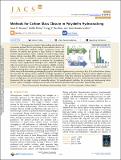
| dc.description.abstract | Heterogeneous catalytic hydrocracking of polyolefins is a promising approach for the processing of postconsumer plastics, but product quantification methods remain inconsistent across the literature. In systems that generate a large fraction of vapor-phase products, typical product capture methods can result in large carbon balance deficits, exceeding 50%, compromising reported yields and selectivities. Here, we identify the major sources of product loss and develop enhanced capture methods to improve the quantification accuracy. Seven supplemental techniques were evaluated, targeting either increased vapor recovery (by increasing the volatility or system volume) or enhanced retention in the liquid phase (by decreasing volatility). Among these, a flow collection approach using a continuous helium sweep and downstream gas sampling bag capture yielded the highest recovery, achieving a 96 ± 9.2% carbon balance closure. We show that the efficacy of these methods is strongly dependent on product distribution. In general, solvent addition was most effective when condensable species dominate the product distribution, while flow collection was preferred when both condensable species and light gases are present in high concentrations. These results highlight the need for method-specific workup strategies and demonstrate that no single protocol is universally optimal. We provide general guidelines for selecting and implementing robust product capture techniques, enabling accurate yield and selectivity determinations in polyolefin hydrocracking systems. | en_US |
| dc.language.iso | en | |
| dc.publisher | American Chemical Society | en_US |
| dc.relation.isversionof | 10.1021/jacsau.5c00476 | en_US |
| dc.rights | Creative Commons Attribution-NonCommercial-NoDerivatives | en_US |
| dc.rights.uri | https://creativecommons.org/licenses/by-nc-nd/4.0/ | en_US |
| dc.source | American Chemical Society | en_US |
| dc.title | Methods for Carbon Mass Closure in Polyolefin Hydrocracking | en_US |
| dc.type | Article | en_US |
| dc.identifier.citation | Anna E. Brenner, Griffin Drake, Gregg T. Beckham, and Yuriy Román-Leshkov. JACS Au 2025 5 (8), 4123-4132. | en_US |
| dc.contributor.department | Massachusetts Institute of Technology. Department of Chemical Engineering | en_US |
| dc.relation.journal | JACS Au | en_US |
| dc.eprint.version | Final published version | en_US |
| dc.type.uri | http://purl.org/eprint/type/JournalArticle | en_US |
| eprint.status | http://purl.org/eprint/status/PeerReviewed | en_US |
| dc.date.updated | 2025-11-25T20:30:03Z | |
| dspace.orderedauthors | Brenner, AE; Drake, G; Beckham, GT; Román-Leshkov, Y | en_US |
| dspace.date.submission | 2025-11-25T20:30:05Z | |
| mit.journal.volume | 5 | en_US |
| mit.journal.issue | 8 | en_US |
| mit.license | PUBLISHER_CC | |
| mit.metadata.status | Authority Work and Publication Information Needed | en_US |