

A11yShape: AI-Assisted 3-D Modeling for Blind and Low-Vision Programmers
Download3663547.3746362.pdf (7.130Mb)
Publisher with Creative Commons License
Publisher with Creative Commons License
Creative Commons Attribution
Terms of use
Metadata
Show full item recordAbstract
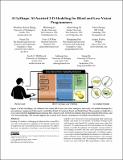
Building 3-D models is challenging for blind and low-vision (BLV) users due to the inherent complexity of 3-D models and the lack of support for non-visual interaction in existing tools. To address this issue, we introduce A11yShape, a novel system designed to help BLV users who possess basic programming skills understand, modify, and iterate on 3-D models. A11yShape leverages LLMs and integrates with OpenSCAD, a popular open-source editor that generates 3-D models from code. Key functionalities of A11yShape include accessible descriptions of 3-D models, version control to track changes in models and code, and a hierarchical representation of model components. Most importantly, A11yShape employs a cross-representation highlighting mechanism to synchronize semantic selections across all model representations—code, semantic hierarchy, AI description, and 3-D rendering. We conducted a multi-session user study with four BLV programmers, where, after an initial tutorial session, participants independently completed 12 distinct models across two testing sessions, achieving results that aligned with their own satisfaction. The result demonstrates that participants were able to comprehend provided 3-D models, as well as independently create and modify 3-D models—tasks that were previously impossible without assistance from sighted individuals.
Description
ASSETS ’25, Denver, CO, USA
Date issued
2025-10-22Department
Massachusetts Institute of Technology. Computer Science and Artificial Intelligence LaboratoryPublisher
ACM|The 27th International ACM SIGACCESS Conference on Computers and Accessibility
Citation
Zhuohao (Jerry) Zhang, Haichang Li, Chun Meng Yu, Faraz Faruqi, Junan
Xie, Gene S-H Kim, Mingming Fan, Angus Forbes, Jacob O. Wobbrock,
Anhong Guo, and Liang He. 2025. A11yShape: AI-Assisted 3-D Modeling
for Blind and Low-Vision Programmers. In The 27th International ACM
SIGACCESS Conference on Computers and Accessibility (ASSETS ’25), October
26–29, 2025, Denver, CO, USA. ACM, New York, NY, USA, 20 pages.
Version: Final published version
ISBN
979-8-4007-0676-9