| dc.contributor.author | Sroczyk, Ewa A | |
| dc.contributor.author | Tarasiuk, Aleksandra | |
| dc.contributor.author | Talar, Marcin | |
| dc.contributor.author | Rutledge, Gregory C | |
| dc.contributor.author | Makaro, Adam | |
| dc.contributor.author | Misztal, Zofia | |
| dc.contributor.author | Wołyniak, Maria | |
| dc.contributor.author | Berniak, Krzysztof | |
| dc.contributor.author | Sałaga, Maciej | |
| dc.contributor.author | Fichna, Jakub | |
| dc.contributor.author | Stachewicz, Urszula | |
| dc.date.accessioned | 2025-12-05T17:13:34Z | |
| dc.date.available | 2025-12-05T17:13:34Z | |
| dc.date.issued | 2024-07-12 | |
| dc.identifier.uri | https://hdl.handle.net/1721.1/164213 | |
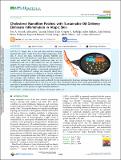
| dc.description.abstract | Atopic skin is dry and itchy and lacks integrity. Impaired skin barrier results from altered lipid composition of the skin. A crucial skin lipid, cholesterol, provides flexibility and homeostasis of the cell membranes' lipid bilayer. Cholesterol-based creams and natural oils, especially blackcurrant seed oil, are beneficial for skin care as they hydrate the skin and improve its integrity. The major atopic symptom, skin dryness, can be overcome by the application of porous patches enhanced with cholesterol and natural oil. The base of the patches is constructed of polyimide (PI) nanofibers with cholesterol coatings and externally added blackcurrant seed oil. The presence of cholesterol in PI mats hinders the passage of oil through the patches to the skin, resulting in sustained and prolonged skin hydration. The theoretical and numerical investigations of oil dynamics in porous mats confirmed the experimental results, showing a prolonged skin hydration effect up to 6 h. Additionally, as demonstrated by in vivo tests on atopic mice, cholesterol patches lower serum immunoglobulin E levels and expression of proinflammatory cytokines in the skin, thereby accelerating skin healing. Our results hold great promise for the long-term application of the patches in atopic dermatitis treatment. | en_US |
| dc.language.iso | en | |
| dc.publisher | American Chemical Society | en_US |
| dc.relation.isversionof | 10.1021/acsami.4c09400 | en_US |
| dc.rights | Creative Commons Attribution | en_US |
| dc.rights.uri | https://creativecommons.org/licenses/by/4.0/ | en_US |
| dc.source | American Chemical Society | en_US |
| dc.title | Cholesterol Nanofiber Patches with Sustainable Oil Delivery Eliminate Inflammation in Atopic Skin | en_US |
| dc.type | Article | en_US |
| dc.identifier.citation | Cholesterol Nanofiber Patches with Sustainable Oil Delivery Eliminate Inflammation in Atopic Skin
Ewa A. Sroczyk, Aleksandra Tarasiuk, Marcin Talar, Gregory C. Rutledge, Adam Makaro, Zofia Misztal, Maria Wołyniak, Krzysztof Berniak, Maciej Sałaga, Jakub Fichna, and Urszula Stachewicz. ACS Applied Materials & Interfaces 2024 16 (29), 37783-37794. | en_US |
| dc.contributor.department | Massachusetts Institute of Technology. Department of Chemical Engineering | en_US |
| dc.relation.journal | ACS Applied Materials & Interfaces | en_US |
| dc.eprint.version | Final published version | en_US |
| dc.type.uri | http://purl.org/eprint/type/JournalArticle | en_US |
| eprint.status | http://purl.org/eprint/status/PeerReviewed | en_US |
| dc.date.updated | 2025-12-05T17:04:17Z | |
| dspace.orderedauthors | Sroczyk, EA; Tarasiuk, A; Talar, M; Rutledge, GC; Makaro, A; Misztal, Z; Wołyniak, M; Berniak, K; Sałaga, M; Fichna, J; Stachewicz, U | en_US |
| dspace.date.submission | 2025-12-05T17:04:28Z | |
| mit.journal.volume | 16 | en_US |
| mit.journal.issue | 29 | en_US |
| mit.license | PUBLISHER_CC | |
| mit.metadata.status | Authority Work and Publication Information Needed | en_US |