| dc.contributor.author | Chang, Yue | |
| dc.contributor.author | Benchekroun, Otman | |
| dc.contributor.author | Chiaramonte, Maurizio M. | |
| dc.contributor.author | Chen, Peter Yichen | |
| dc.contributor.author | Grinspun, Eitan | |
| dc.date.accessioned | 2026-02-09T15:40:12Z | |
| dc.date.available | 2026-02-09T15:40:12Z | |
| dc.date.issued | 2025-07-27 | |
| dc.identifier.issn | 0730-0301 | |
| dc.identifier.uri | https://hdl.handle.net/1721.1/164758 | |
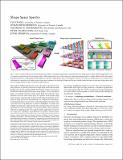
| dc.description.abstract | Eigenanalysis of differential operators, such as the Laplace operator or elastic energy Hessian, is typically restricted to a single shape and its discretization, limiting reduced order modeling (ROM). We introduce the first eigenanalysis method for continuously parameterized shape families. Given a parametric shape, our method constructs spatial neural fields that represent eigen-functions across the entire shape space. It is agnostic to the specific shape representation, requiring only an inside/outside indicator function that depends on shape parameters. Eigenfunctions are computed by minimizing a variational principle over nested spaces with orthogonality constraints. Since eigenvalues may swap dominance at points of multiplicity, we jointly train multiple eigenfunctions while dynamically reordering them based on their eigenvalues at each step. Through causal gradient filtering, this reordering is reflected in backpropagation. Our method enables applications to operate over shape space, providing a single ROM that encapsulates vibration modes for all shapes, including previously unseen ones. Since our eigenanalysis is differentiable with respect to shape parameters, it facilitates eigenfunction-aware shape optimization. We evaluate our approach on shape optimization for sound synthesis and locomotion, as well as reduced-order modeling for elastodynamic simulation. | en_US |
| dc.publisher | ACM | en_US |
| dc.relation.isversionof | https://doi.org/10.1145/3731148 | en_US |
| dc.rights | Article is made available in accordance with the publisher's policy and may be subject to US copyright law. Please refer to the publisher's site for terms of use. | en_US |
| dc.source | Association for Computing Machinery | en_US |
| dc.title | Shape Space Spectra | en_US |
| dc.type | Article | en_US |
| dc.identifier.citation | Yue Chang, Otman Benchekroun, Maurizio M. Chiaramonte, Peter Yichen Chen, and Eitan Grinspun. 2025. Shape Space Spectra. ACM Trans. Graph. 44, 4, Article 121 (August 2025), 16 pages. | en_US |
| dc.contributor.department | Massachusetts Institute of Technology. Computer Science and Artificial Intelligence Laboratory | en_US |
| dc.relation.journal | ACM Transactions on Graphics | en_US |
| dc.identifier.mitlicense | PUBLISHER_POLICY | |
| dc.eprint.version | Final published version | en_US |
| dc.type.uri | http://purl.org/eprint/type/JournalArticle | en_US |
| eprint.status | http://purl.org/eprint/status/PeerReviewed | en_US |
| dc.date.updated | 2025-08-01T08:59:08Z | |
| dc.language.rfc3066 | en | |
| dc.rights.holder | The author(s) | |
| dspace.date.submission | 2025-08-01T08:59:09Z | |
| mit.journal.volume | 44 | en_US |
| mit.journal.issue | 4 | en_US |
| mit.license | PUBLISHER_POLICY | |
| mit.metadata.status | Authority Work and Publication Information Needed | en_US |