| dc.contributor.author | Dodik, Ana | |
| dc.contributor.author | Yu, Isabella | |
| dc.contributor.author | Chandra, Kartik | |
| dc.contributor.author | Ragan-Kelley, Jonathan | |
| dc.contributor.author | Tenenbaum, Joshua | |
| dc.contributor.author | Sitzmann, Vincent | |
| dc.contributor.author | Solomon, Justin | |
| dc.date.accessioned | 2026-02-13T17:17:28Z | |
| dc.date.available | 2026-02-13T17:17:28Z | |
| dc.date.issued | 2025-07-27 | |
| dc.identifier.issn | 0730-0301 | |
| dc.identifier.uri | https://hdl.handle.net/1721.1/164877 | |
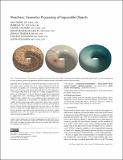
| dc.description.abstract | Impossible objects, geometric constructions that humans can perceive but that cannot exist in real life, have been a topic of intrigue in visual arts, perception, and graphics, yet no satisfying computer representation of such objects exists. Previous work embeds impossible objects in 3D, cutting them or twisting/bending them in the depth axis. Cutting an impossible object changes its local geometry at the cut, which can hamper downstream graphics applications, such as smoothing, while bending makes it difficult to relight the object. Both of these can invalidate geometry operations, such as distance computation. As an alternative, we introduce Meschers, meshes capable of representing impossible constructions akin to those found in M.C. Escher's woodcuts. Our representation has a theoretical foundation in discrete exterior calculus and supports the use-cases above, as we demonstrate in a number of example applications. Moreover, because we can do discrete geometry processing on our representation, we can inverse-render impossible objects. We also compare our representation to cut and bend representations of impossible objects. | en_US |
| dc.publisher | ACM | en_US |
| dc.relation.isversionof | https://doi.org/10.1145/3731422 | en_US |
| dc.rights | Creative Commons Attribution-Noncommercial-ShareAlike | en_US |
| dc.rights.uri | http://creativecommons.org/licenses/by-nc-sa/4.0/ | en_US |
| dc.source | Association for Computing Machinery | en_US |
| dc.title | Meschers: Geometry Processing of Impossible Objects | en_US |
| dc.type | Article | en_US |
| dc.identifier.citation | Ana Dodik, Isabella Yu, Kartik Chandra, Jonathan Ragan-Kelley, Joshua Tenenbaum, Vincent Sitzmann, and Justin Solomon. 2025. Meschers: Geometry Processing of Impossible Objects. ACM Trans. Graph. 44, 4, Article 70 (August 2025), 10 pages. | en_US |
| dc.contributor.department | Massachusetts Institute of Technology. Computer Science and Artificial Intelligence Laboratory | en_US |
| dc.relation.journal | ACM Transactions on Graphics | en_US |
| dc.identifier.mitlicense | PUBLISHER_POLICY | |
| dc.eprint.version | Final published version | en_US |
| dc.type.uri | http://purl.org/eprint/type/JournalArticle | en_US |
| eprint.status | http://purl.org/eprint/status/PeerReviewed | en_US |
| dc.date.updated | 2025-08-01T09:00:19Z | |
| dc.language.rfc3066 | en | |
| dc.rights.holder | The author(s) | |
| dspace.date.submission | 2025-08-01T09:00:20Z | |
| mit.journal.volume | 44 | en_US |
| mit.journal.issue | 4 | en_US |
| mit.license | PUBLISHER_CC | |
| mit.metadata.status | Authority Work and Publication Information Needed | en_US |