| dc.contributor.author | Yuille, Alan | |
| dc.contributor.author | Zhu, Long | |
| dc.date.accessioned | 2010-11-12T18:39:10Z | |
| dc.date.available | 2010-11-12T18:39:10Z | |
| dc.date.issued | 2009-08 | |
| dc.date.submitted | 2009-06 | |
| dc.identifier.isbn | 978-1-4244-3994-2 | |
| dc.identifier.other | INSPEC Accession Number: 10836225 | |
| dc.identifier.uri | http://hdl.handle.net/1721.1/59972 | |
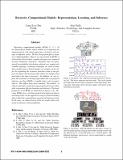
| dc.description.abstract | Recursive compositional models (RCMs) are hierarchical models which enable us to represent the shape/geometry and visual appearance of objects and images at different scales. The key design principle is recursive compositionality. Objects are represented by RCMs in a hierarchical form where complex structures are composed of more elementary structures. Formally, they are represented by probability distributions defined over graphs with variable topology. Learning techniques are used to learn these models from a limited number of examples of the object by exploiting the recursive structure (some of our papers use supervised learning while others are unsupervised and induce the object structure). In addition, we can exploit this structure to develop algorithms that can perform inference on these RCMs to rapidly detect and recognize objects. This differs from more standard "flat models" of objects which have much less representational power if they wish to maintain efficient learning and inference. The basic properties of an RCM are illustrated in figures (1, 2). Because RCMs give a rich hierarchical description of objects and images they can be applied to a range of tasks including object detection, segmentation, parsing and image parsing. In all cases, we achieved state of the art results when evaluated on datasets with groundtruth. | en_US |
| dc.language.iso | en_US | |
| dc.publisher | Institute of Electrical and Electronics Engineers | en_US |
| dc.relation.isversionof | http://dx.doi.org/10.1109/CVPR.2009.5204330 | en_US |
| dc.rights | Article is made available in accordance with the publisher's policy and may be subject to US copyright law. Please refer to the publisher's site for terms of use. | en_US |
| dc.source | IEEE | en_US |
| dc.title | Recursive compositional models: representation, learning, and inference | en_US |
| dc.type | Article | en_US |
| dc.identifier.citation | Long Zhu, and A. Yuille. “Recursive compositional models: Representation, learning, and inference.” Computer Vision and Pattern Recognition Workshops, 2009. CVPR Workshops 2009. IEEE Computer Society Conference on. 2009. 5. ©2009 IEEE. | en_US |
| dc.contributor.department | Massachusetts Institute of Technology. Computer Science and Artificial Intelligence Laboratory | en_US |
| dc.contributor.approver | Zhu, Long | |
| dc.contributor.mitauthor | Zhu, Long | |
| dc.relation.journal | IEEE Computer Society Conference on Computer Vision and Pattern Recognition Workshops, 2009. CVPR Workshops 2009 | en_US |
| dc.eprint.version | Final published version | en_US |
| dc.type.uri | http://purl.org/eprint/type/ConferencePaper | en_US |
| dspace.orderedauthors | Long Zhu; Yuille, A. | en |
| mit.license | PUBLISHER_POLICY | en_US |
| mit.metadata.status | Complete | |