| dc.contributor.author | Demanet, Laurent | |
| dc.contributor.author | Ying, Lexing | |
| dc.date.accessioned | 2011-06-21T16:53:22Z | |
| dc.date.available | 2011-06-21T16:53:22Z | |
| dc.date.issued | 2010-06 | |
| dc.date.submitted | 2009-10 | |
| dc.identifier.issn | 1615-3375 | |
| dc.identifier.issn | 1615-3383 | |
| dc.identifier.uri | http://hdl.handle.net/1721.1/64629 | |
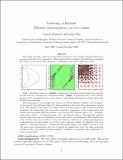
| dc.description.abstract | This paper presents a numerical compression strategy for the boundary integral equation of acoustic scattering in two dimensions. These equations have oscillatory kernels that we represent in a basis of wave atoms, and compress by thresholding the small coefficients to zero.
This phenomenon was perhaps first observed in 1993 by Bradie, Coifman, and Grossman, in the context of local Fourier bases (Bradie et al. in Appl. Comput. Harmon. Anal. 1:94–99, 1993). Their results have since then been extended in various ways. The purpose of this paper is to bridge a theoretical gap and prove that a well-chosen fixed expansion, the non-standard wave atom form, provides a compression of the acoustic single- and double-layer potentials with wave number k as O(k)-by-O(k) matrices with C ε δ k 1+δ non-negligible entries, with δ>0 arbitrarily small, and ε the desired accuracy. The argument assumes smooth, separated, and not necessarily convex scatterers in two dimensions. The essential features of wave atoms that allow this result to be written as a theorem are a sharp time-frequency localization that wavelet packets do not obey, and a parabolic scaling (wavelength of the wave packet) ∼ (essential diameter)2. Numerical experiments support the estimate and show that this wave atom representation may be of interest for applications where the same scattering problem needs to be solved for many boundary conditions, for example, the computation of radar cross sections. | en_US |
| dc.language.iso | en_US | |
| dc.publisher | Springer New York | en_US |
| dc.relation.isversionof | http://dx.doi.org/10.1007/s10208-010-9070-4 | en_US |
| dc.rights | Creative Commons Attribution-Noncommercial-Share Alike 3.0 | en_US |
| dc.rights.uri | http://creativecommons.org/licenses/by-nc-sa/3.0/ | en_US |
| dc.source | Prof. Demanet via Michael Noga | en_US |
| dc.title | Scattering in Flatland: Efficient Representations via Wave Atoms | en_US |
| dc.type | Article | en_US |
| dc.identifier.citation | Demanet, Laurent, and Lexing Ying. “Scattering in Flatland: Efficient Representations via Wave Atoms.” Foundations of Computational Mathematics 10.5 (2010) : 569-613. | en_US |
| dc.contributor.department | Massachusetts Institute of Technology. Department of Mathematics | en_US |
| dc.contributor.approver | Demanet, Laurent | |
| dc.contributor.mitauthor | Demanet, Laurent | |
| dc.relation.journal | Foundations of Computational Mathematics | en_US |
| dc.eprint.version | Author's final manuscript | en_US |
| dc.type.uri | http://purl.org/eprint/type/JournalArticle | en_US |
| eprint.status | http://purl.org/eprint/status/PeerReviewed | en_US |
| dspace.orderedauthors | Demanet, Laurent; Ying, Lexing | en |
| dc.identifier.orcid | https://orcid.org/0000-0001-7052-5097 | |
| mit.license | OPEN_ACCESS_POLICY | en_US |
| mit.metadata.status | Complete | |