MIT Libraries logoDSpace@MIT

MIT
View Item 
  • DSpace@MIT Home
  • MIT Open Access Articles
  • MIT Open Access Articles
  • View Item
  • DSpace@MIT Home
  • MIT Open Access Articles
  • MIT Open Access Articles
  • View Item
JavaScript is disabled for your browser. Some features of this site may not work without it.

Capillary origami in nature
Author(s)
Jung, Sunghwan; Reis, Pedro Miguel; James, Jillian; Clanet, Christophe; Bush, John W. M.
Thumbnail
DownloadReis_Capillary Origami.pdf (463.7Kb)
PUBLISHER_POLICY

Publisher Policy

Article is made available in accordance with the publisher's policy and may be subject to US copyright law. Please refer to the publisher's site for terms of use.

Terms of use
Article is made available in accordance with the publisher's policy and may be subject to US copyright law. Please refer to the publisher's site for terms of use.
Metadata
Show full item record
Abstract
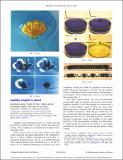
Capillary forces dominate gravity on a small scale and may deform flexible bodies in both natural and laboratory settings. Two examples are considered here: floating flowers and spider webs.
Date issued
2009-09
URI
http://hdl.handle.net/1721.1/66217
Department
Massachusetts Institute of Technology. Department of Civil and Environmental Engineering; Massachusetts Institute of Technology. Department of Mathematics
Journal
Physics of Fluids
Publisher
American Institute of Physics
Citation
Jung, Sunghwan et al. “Capillary origami in nature.” Physics of Fluids 21 (2009): 091110.
Version: Final published version
ISSN
1070-6631
1089-7666

Collections
  • MIT Open Access Articles

Browse

All of DSpaceCommunities & CollectionsBy Issue DateAuthorsTitlesSubjectsThis CollectionBy Issue DateAuthorsTitlesSubjects

My Account

Login

Statistics

OA StatisticsStatistics by CountryStatistics by Department
MIT Libraries
PrivacyPermissionsAccessibilityContact us
MIT
Content created by the MIT Libraries, CC BY-NC unless otherwise noted. Notify us about copyright concerns.