| dc.contributor.author | Yu, Yimin | |
| dc.contributor.author | Israelsen, William James | |
| dc.contributor.author | Mattaini, Katherine Ruth | |
| dc.contributor.author | Fiske, Brian Prescott | |
| dc.contributor.author | Malstrom, Scott E. | |
| dc.contributor.author | Khan, Tahsin M. | |
| dc.contributor.author | Lunt, Sophia Yunkyungkwon | |
| dc.contributor.author | Johnson, Zachary | |
| dc.contributor.author | Davidson, Shawn Michael | |
| dc.contributor.author | Vander Heiden, Matthew G. | |
| dc.contributor.author | Jha, Abhishek K. | |
| dc.contributor.author | Stephano, Gregory | |
| dc.date.accessioned | 2013-03-15T18:56:26Z | |
| dc.date.available | 2013-03-15T18:56:26Z | |
| dc.date.issued | 2012-10 | |
| dc.date.submitted | 2011-11 | |
| dc.identifier.issn | 1552-4450 | |
| dc.identifier.issn | 1552-4469 | |
| dc.identifier.uri | http://hdl.handle.net/1721.1/77922 | |
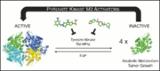
| dc.description.abstract | Cancer cells engage in a metabolic program to enhance biosynthesis and support cell proliferation. The regulatory properties of pyruvate kinase M2 (PKM2) influence altered glucose metabolism in cancer. The interaction of PKM2 with phosphotyrosine-containing proteins inhibits enzyme activity and increases the availability of glycolytic metabolites to support cell proliferation. This suggests that high pyruvate kinase activity may suppress tumor growth. We show that expression of PKM1, the pyruvate kinase isoform with high constitutive activity, or exposure to published small-molecule PKM2 activators inhibits the growth of xenograft tumors. Structural studies reveal that small-molecule activators bind PKM2 at the subunit interaction interface, a site that is distinct from that of the endogenous activator fructose-1,6-bisphosphate (FBP). However, unlike FBP, binding of activators to PKM2 promotes a constitutively active enzyme state that is resistant to inhibition by tyrosine-phosphorylated proteins. These data support the notion that small-molecule activation of PKM2 can interfere with anabolic metabolism. | en_US |
| dc.description.sponsorship | National Institutes of Health (U.S.) (NIH grant R01 GM56203) | en_US |
| dc.description.sponsorship | National Institutes of Health (U.S.) (grant NIH 5P01CA120964) | en_US |
| dc.description.sponsorship | Dana-Farber/Harvard Cancer Center (NIH 5P30CA006516) | en_US |
| dc.description.sponsorship | National Institutes of Health (U.S.) (NIH grant R03MH085679) | en_US |
| dc.description.sponsorship | National Human Genome Research Institute (U.S.) (Intramural Research Program) | en_US |
| dc.description.sponsorship | National Institutes of Health (U.S.) (Molecular Libraries Initiative of the NIH Roadmap for Medical Research) | en_US |
| dc.language.iso | en_US | |
| dc.publisher | Nature Publishing Group | en_US |
| dc.relation.isversionof | http://dx.doi.org/10.1038/nchembio.1060 | en_US |
| dc.rights | Article is made available in accordance with the publisher's policy and may be subject to US copyright law. Please refer to the publisher's site for terms of use. | en_US |
| dc.source | Vander Heiden via Courtney Crummett | en_US |
| dc.title | Pyruvate kinase M2 activators promote tetramer formation and suppress tumorigenesis | en_US |
| dc.type | Article | en_US |
| dc.identifier.citation | Anastasiou, Dimitrios et al. “Pyruvate Kinase M2 Activators Promote Tetramer Formation and Suppress Tumorigenesis.” Nature Chemical Biology 8.10 (2012): 839–847. CrossRef. | en_US |
| dc.contributor.department | Massachusetts Institute of Technology. Department of Biology | en_US |
| dc.contributor.department | Massachusetts Institute of Technology. Department of Chemical Engineering | en_US |
| dc.contributor.department | Koch Institute for Integrative Cancer Research at MIT | en_US |
| dc.contributor.approver | Vander Heiden, Matthew G. | |
| dc.contributor.mitauthor | Stephanopoulos, Gregory | |
| dc.contributor.mitauthor | Jha, Abhishek K. | |
| dc.contributor.mitauthor | Yu, Yimin | |
| dc.contributor.mitauthor | Israelsen, William James | |
| dc.contributor.mitauthor | Mattaini, Katherine Ruth | |
| dc.contributor.mitauthor | Fiske, Brian Prescott | |
| dc.contributor.mitauthor | Malstrom, Scott E. | |
| dc.contributor.mitauthor | Khan, Tahsin M. | |
| dc.contributor.mitauthor | Lunt, Sophia Yunkyungkwon | |
| dc.contributor.mitauthor | Johnson, Zachary | |
| dc.contributor.mitauthor | Davidson, Shawn Michael | |
| dc.contributor.mitauthor | Vander Heiden, Matthew G. | |
| dc.relation.journal | Nature Chemical Biology | en_US |
| dc.eprint.version | Author's final manuscript | en_US |
| dc.type.uri | http://purl.org/eprint/type/JournalArticle | en_US |
| eprint.status | http://purl.org/eprint/status/PeerReviewed | en_US |
| dspace.orderedauthors | Anastasiou, Dimitrios; Yu, Yimin; Israelsen, William J; Jiang, Jian-Kang; Boxer, Matthew B; Hong, Bum Soo; Tempel, Wolfram; Dimov, Svetoslav; Shen, Min; Jha, Abhishek; Yang, Hua; Mattaini, Katherine R; Metallo, Christian M; Fiske, Brian P; Courtney, Kevin D; Malstrom, Scott; Khan, Tahsin M; Kung, Charles; Skoumbourdis, Amanda P; Veith, Henrike; Southall, Noel; Walsh, Martin J; Brimacombe, Kyle R; Leister, William; Lunt, Sophia Y; Johnson, Zachary R; Yen, Katharine E; Kunii, Kaiko; Davidson, Shawn M; Christofk, Heather R; Austin, Christopher P; Inglese, James; Harris, Marian H; Asara, John M; Stephanopoulos, Gregory; Salituro, Francesco G; Jin, Shengfang; Dang, Lenny; Auld, Douglas S; Park, Hee-Won; Cantley, Lewis C; Thomas, Craig J; Vander Heiden, Matthew G | en |
| dc.identifier.orcid | https://orcid.org/0000-0002-6702-4192 | |
| dc.identifier.orcid | https://orcid.org/0000-0003-0046-1360 | |
| dc.identifier.orcid | https://orcid.org/0000-0001-6909-4568 | |
| dc.identifier.orcid | https://orcid.org/0000-0003-0701-5275 | |
| dspace.mitauthor.error | true | |
| mit.license | PUBLISHER_POLICY | en_US |
| mit.metadata.status | Complete | |