| dc.contributor.author | Ohannessian, Mesrob I. | |
| dc.contributor.author | Dahleh, Munther A. | |
| dc.date.accessioned | 2014-04-07T19:37:07Z | |
| dc.date.available | 2014-04-07T19:37:07Z | |
| dc.date.issued | 2012-03 | |
| dc.identifier.isbn | 978-1-4673-3140-1 | |
| dc.identifier.isbn | 978-1-4673-3139-5 | |
| dc.identifier.isbn | 978-1-4673-3138-8 | |
| dc.identifier.uri | http://hdl.handle.net/1721.1/86079 | |
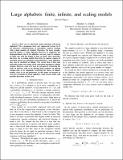
| dc.description.abstract | How can we effectively model situations with large alphabets? On a pragmatic level, any engineered system, be it for inference, communication, or encryption, requires working with a finite number of symbols. Therefore, the most straight-forward model is a finite alphabet. However, to emphasize the disproportionate size of the alphabet, one may want to compare its finite size with the length of data at hand. More generally, this gives rise to scaling models that strive to capture regimes of operation where one anticipates such imbalance. Large alphabets may also be idealized as infinite. The caveat then is that such generality strips away many of the convenient machinery of finite settings. However, some of it may be salvaged by refocusing the tasks of interest, such as by moving from sequence to pattern compression, or by minimally restricting the classes of infinite models, such as via tail properties. In this paper we present an overview of models for large alphabets, some recent results, and possible directions in this area. | en_US |
| dc.language.iso | en_US | |
| dc.publisher | Institute of Electrical and Electronics Engineers (IEEE) | en_US |
| dc.relation.isversionof | http://dx.doi.org/10.1109/CISS.2012.6310941 | en_US |
| dc.rights | Creative Commons Attribution-Noncommercial-Share Alike | en_US |
| dc.rights.uri | http://creativecommons.org/licenses/by-nc-sa/4.0/ | en_US |
| dc.source | MIT web domain | en_US |
| dc.title | Large alphabets: Finite, infinite, and scaling models | en_US |
| dc.type | Article | en_US |
| dc.identifier.citation | Ohannessian, Mesrob I., and Munther A. Dahleh. “Large Alphabets: Finite, Infinite, and Scaling Models.” 2012 46th Annual Conference on Information Sciences and Systems (CISS) (n.d.). | en_US |
| dc.contributor.department | Massachusetts Institute of Technology. Engineering Systems Division | en_US |
| dc.contributor.department | Massachusetts Institute of Technology. Laboratory for Information and Decision Systems | en_US |
| dc.contributor.mitauthor | Ohannessian, Mesrob I. | en_US |
| dc.contributor.mitauthor | Dahleh, Munther A. | en_US |
| dc.relation.journal | Proceedings of the 2012 46th Annual Conference on Information Sciences and Systems (CISS) | en_US |
| dc.eprint.version | Author's final manuscript | en_US |
| dc.type.uri | http://purl.org/eprint/type/ConferencePaper | en_US |
| eprint.status | http://purl.org/eprint/status/NonPeerReviewed | en_US |
| dspace.orderedauthors | Ohannessian, Mesrob I.; Dahleh, Munther A. | en_US |
| dc.identifier.orcid | https://orcid.org/0000-0002-1470-2148 | |
| mit.license | OPEN_ACCESS_POLICY | en_US |
| mit.metadata.status | Complete | |