| dc.contributor.author | Brandao, Fernando G.S.L. | |
| dc.contributor.author | Harrow, Aram W. | |
| dc.contributor.author | Lee, James R. | |
| dc.contributor.author | Peres, Yuval | |
| dc.date.accessioned | 2014-07-22T12:00:02Z | |
| dc.date.available | 2014-07-22T12:00:02Z | |
| dc.date.issued | 2014-01 | |
| dc.identifier.isbn | 9781450326988 | |
| dc.identifier.uri | http://hdl.handle.net/1721.1/88449 | |
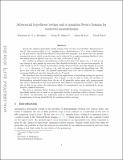
| dc.description.abstract | Recall the classical hypothesis testing setting with two convex sets of probability distributions P and Q. One receives either n i.i.d. samples from a distribution p ∈ P or from a distribution q ∈ Q and wants to decide from which set the points were sampled. It is known that the optimal exponential rate at which errors decrease can be achieved by a simple maximum-likelihood ratio test which does not depend on p or q, but only on the sets P and Q.
We consider an adaptive generalization of this model where the choice of p ∈ P and q ∈ Q can change in each sample in some way that depends arbitrarily on the previous samples. In other words, in the kth round, an adversary, having observed all the previous samples in rounds 1, ..., κ-1, chooses p[subscript κ] ∈ P and q[subscript κ] ∈ Q, with the goal of confusing the hypothesis test. We prove that even in this case, the optimal exponential error rate can be achieved by a simple maximum-likelihood test that depends only on P and Q.
We then show that the adversarial model has applications in hypothesis testing for quantum states using restricted measurements. For example, it can be used to study the problem of distinguishing entangled states from the set of all separable states using only measurements that can be implemented with local operations and classical communication (LOCC). The basic idea is that in our setup, the deleterious effects of entanglement can be simulated by an adaptive classical adversary.
We prove a quantum Stein's Lemma in this setting: In many circumstances, the optimal hypothesis testing rate is equal to an appropriate notion of quantum relative entropy between two states. In particular, our arguments yield an alternate proof of Li and Winter's recent strengthening of strong subadditivity for quantum relative entropy. | en_US |
| dc.description.sponsorship | National Science Foundation (U.S.) (Grant CCF-1111382) | en_US |
| dc.description.sponsorship | United States. Army Research Office (Contract W911NF-12-1-0486) | en_US |
| dc.language.iso | en_US | |
| dc.publisher | Association for Computing Machinery (ACM) | en_US |
| dc.relation.isversionof | http://dx.doi.org/10.1145/2554797.2554816 | en_US |
| dc.rights | Creative Commons Attribution-Noncommercial-Share Alike | en_US |
| dc.rights.uri | http://creativecommons.org/licenses/by-nc-sa/4.0/ | en_US |
| dc.source | arXiv | en_US |
| dc.title | Adversarial hypothesis testing and a quantum stein's lemma for restricted measurements | en_US |
| dc.type | Article | en_US |
| dc.identifier.citation | Fernando G.S.L. Brandao, Aram W. Harrow, James R. Lee, and Yuval Peres. 2014. Adversarial hypothesis testing and a quantum stein's lemma for restricted measurements. In Proceedings of the 5th conference on Innovations in theoretical computer science (ITCS '14). ACM, New York, NY, USA, 183-194. | en_US |
| dc.contributor.department | Massachusetts Institute of Technology. Department of Physics | en_US |
| dc.contributor.mitauthor | Harrow, Aram W. | en_US |
| dc.relation.journal | Proceedings of the 5th conference on Innovations in theoretical computer science (ITCS '14) | en_US |
| dc.eprint.version | Author's final manuscript | en_US |
| dc.type.uri | http://purl.org/eprint/type/ConferencePaper | en_US |
| eprint.status | http://purl.org/eprint/status/NonPeerReviewed | en_US |
| dspace.orderedauthors | Brandao, Fernando G.S.L.; Harrow, Aram W.; Lee, James R.; Peres, Yuval | en_US |
| dc.identifier.orcid | https://orcid.org/0000-0003-3220-7682 | |
| mit.license | OPEN_ACCESS_POLICY | en_US |
| mit.metadata.status | Complete | |