The MIT Libraries is completing a major upgrade to DSpace@MIT.
Starting May 5 2026, DSpace will remain functional, viewable, searchable, and downloadable, however, you will not be able to edit existing collections or add new material.
We are aiming to have full functionality restored by May 18, 2026, but intermittent service interruptions may occur.
Please email dspace-lib@mit.edu with any questions.
Thank you for your patience as we implement this important upgrade.
Crowdsourcing step-by-step information extraction to enhance existing how-to videos
| dc.contributor.author | Nguyen, Phu Tran | |
| dc.contributor.author | Weir, Sarah | |
| dc.contributor.author | Guo, Philip J. | |
| dc.contributor.author | Miller, Robert C. | |
| dc.contributor.author | Gajos, Krzysztof Z. | |
| dc.contributor.author | Kim, Ju Ho | |
| dc.date.accessioned | 2014-09-26T18:02:11Z | |
| dc.date.available | 2014-09-26T18:02:11Z | |
| dc.date.issued | 2014-04 | |
| dc.identifier.isbn | 9781450324731 | |
| dc.identifier.uri | http://hdl.handle.net/1721.1/90410 | |
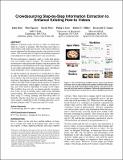
| dc.description.abstract | Millions of learners today use how-to videos to master new skills in a variety of domains. But browsing such videos is often tedious and inefficient because video player interfaces are not optimized for the unique step-by-step structure of such videos. This research aims to improve the learning experience of existing how-to videos with step-by-step annotations. We first performed a formative study to verify that annotations are actually useful to learners. We created ToolScape, an interactive video player that displays step descriptions and intermediate result thumbnails in the video timeline. Learners in our study performed better and gained more self-efficacy using ToolScape versus a traditional video player. To add the needed step annotations to existing how-to videos at scale, we introduce a novel crowdsourcing workflow. It extracts step-by-step structure from an existing video, including step times, descriptions, and before and after images. We introduce the Find-Verify-Expand design pattern for temporal and visual annotation, which applies clustering, text processing, and visual analysis algorithms to merge crowd output. The workflow does not rely on domain-specific customization, works on top of existing videos, and recruits untrained crowd workers. We evaluated the workflow with Mechanical Turk, using 75 cooking, makeup, and Photoshop videos on YouTube. Results show that our workflow can extract steps with a quality comparable to that of trained annotators across all three domains with 77% precision and 81% recall. | en_US |
| dc.language.iso | en_US | |
| dc.publisher | Association for Computing Machinery (ACM) | en_US |
| dc.relation.isversionof | http://dx.doi.org/10.1145/2556288.2556986 | en_US |
| dc.rights | Creative Commons Attribution-Noncommercial-Share Alike | en_US |
| dc.rights.uri | http://creativecommons.org/licenses/by-nc-sa/4.0/ | en_US |
| dc.source | Other univ. web domain | en_US |
| dc.title | Crowdsourcing step-by-step information extraction to enhance existing how-to videos | en_US |
| dc.type | Article | en_US |
| dc.identifier.citation | Juho Kim, Phu Tran Nguyen, Sarah Weir, Philip J. Guo, Robert C. Miller, and Krzysztof Z. Gajos. 2014. Crowdsourcing step-by-step information extraction to enhance existing how-to videos. In Proceedings of the SIGCHI Conference on Human Factors in Computing Systems (CHI '14). ACM, New York, NY, USA, 4017-4026. | en_US |
| dc.contributor.department | Massachusetts Institute of Technology. Computer Science and Artificial Intelligence Laboratory | en_US |
| dc.contributor.department | Massachusetts Institute of Technology. Department of Electrical Engineering and Computer Science | en_US |
| dc.contributor.mitauthor | Kim, Ju Ho | en_US |
| dc.contributor.mitauthor | Nguyen, Phu Tran | en_US |
| dc.contributor.mitauthor | Weir, Sarah | en_US |
| dc.contributor.mitauthor | Miller, Robert C. | en_US |
| dc.relation.journal | Proceedings of the 32nd annual ACM conference on Human factors in computing systems (CHI '14) | en_US |
| dc.eprint.version | Author's final manuscript | en_US |
| dc.type.uri | http://purl.org/eprint/type/ConferencePaper | en_US |
| eprint.status | http://purl.org/eprint/status/NonPeerReviewed | en_US |
| dspace.orderedauthors | Kim, Juho; Nguyen, Phu Tran; Weir, Sarah; Guo, Philip J.; Miller, Robert C.; Gajos, Krzysztof Z. | en_US |
| dc.identifier.orcid | https://orcid.org/0000-0001-6348-4127 | |
| dc.identifier.orcid | https://orcid.org/0000-0002-0442-691X | |
| mit.license | OPEN_ACCESS_POLICY | en_US |
| mit.metadata.status | Complete |