| dc.contributor.author | Huang, Guoquan | |
| dc.contributor.author | Seto, Mae | |
| dc.contributor.author | Paull, Liam | |
| dc.contributor.author | Leonard, John J | |
| dc.date.accessioned | 2017-03-20T15:21:02Z | |
| dc.date.available | 2017-03-20T15:21:02Z | |
| dc.date.issued | 2015-07 | |
| dc.date.submitted | 2015-05 | |
| dc.identifier.isbn | 978-1-4799-6923-4 | |
| dc.identifier.uri | http://hdl.handle.net/1721.1/107495 | |
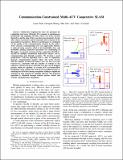
| dc.description.abstract | Multi-robot deployments have the potential for completing tasks more efficiently. For example, in simultaneous localization and mapping (SLAM), robots can better localize themselves and the map if they can share measurements of each other (direct encounters) and of commonly observed parts of the map (indirect encounters). However, performance is contingent on the quality of the communications channel. In the underwater scenario, communicating over any appreciable distance is achieved using acoustics which is low-bandwidth, slow, and unreliable, making cooperative operations very challenging. In this paper, we present a framework for cooperative SLAM (C-SLAM) for multiple autonomous underwater vehicles (AUVs) communicating only through acoustics. We develop a novel graph-based C-SLAM algorithm that is able to (optimally) generate communication packets whose size scales linearly with the number of observed features since the last successful transmission, constantly with the number of vehicles in the collective, and does not grow with time even the case of dropped packets, which are common. As a result, AUVs can bound their localization error without the need for pre-installed beacons or surfacing for GPS fixes during navigation, leading to significant reduction in time required to complete missions. The proposed algorithm is validated through realistic marine vehicle and acoustic communication simulations. | en_US |
| dc.description.sponsorship | United States. Office of Naval Research (Grant N00014-13-1-0588) | en_US |
| dc.description.sponsorship | National Science Foundation (U.S.) (Award IIS-1318392) | en_US |
| dc.description.sponsorship | United States. Office of Naval Research Global | en_US |
| dc.language.iso | en_US | |
| dc.publisher | Institute of Electrical and Electronics Engineers (IEEE) | en_US |
| dc.relation.isversionof | http://dx.doi.org/10.1109/ICRA.2015.7139227 | en_US |
| dc.rights | Creative Commons Attribution-Noncommercial-Share Alike | en_US |
| dc.rights.uri | http://creativecommons.org/licenses/by-nc-sa/4.0/ | en_US |
| dc.source | MIT Web Domain | en_US |
| dc.title | Communication-constrained multi-AUV cooperative SLAM | en_US |
| dc.type | Article | en_US |
| dc.identifier.citation | Paull, Liam et al. “Communication-Constrained Multi-AUV Cooperative SLAM.” IEEE, 2015. 509–516. | en_US |
| dc.contributor.department | Massachusetts Institute of Technology. Computer Science and Artificial Intelligence Laboratory | en_US |
| dc.contributor.department | Massachusetts Institute of Technology. Department of Mechanical Engineering | en_US |
| dc.contributor.mitauthor | Paull, Liam | |
| dc.contributor.mitauthor | Leonard, John J | |
| dc.relation.journal | Proceedings of the 2015 IEEE International Conference on Robotics and Automation (ICRA) | en_US |
| dc.eprint.version | Author's final manuscript | en_US |
| dc.type.uri | http://purl.org/eprint/type/ConferencePaper | en_US |
| eprint.status | http://purl.org/eprint/status/NonPeerReviewed | en_US |
| dspace.orderedauthors | Paull, Liam; Huang, Guoquan; Seto, Mae; Leonard, John J. | en_US |
| dspace.embargo.terms | N | en_US |
| dc.identifier.orcid | https://orcid.org/0000-0003-2492-6660 | |
| dc.identifier.orcid | https://orcid.org/0000-0002-8863-6550 | |
| mit.license | OPEN_ACCESS_POLICY | en_US |