| dc.contributor.author | Dames, Philip M. | |
| dc.contributor.author | Schwager, Mac | |
| dc.contributor.author | Kumar, Vijay | |
| dc.contributor.author | Rus, Daniela L | |
| dc.date.accessioned | 2017-08-28T17:56:27Z | |
| dc.date.available | 2017-08-28T17:56:27Z | |
| dc.date.issued | 2015-12 | |
| dc.identifier.issn | 2377-3766 | |
| dc.identifier.issn | 2377-3774 | |
| dc.identifier.uri | http://hdl.handle.net/1721.1/111027 | |
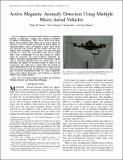
| dc.description.abstract | Magnetic anomaly detection (MAD) is an important problem in applications ranging from geological surveillance to military reconnaissance. MAD sensors detect local disturbances in the magnetic field, which can be used to detect the existence of and to estimate the position of buried, hidden, or submerged objects, such as ore deposits or mines. These sensors may experience false positive and false negative detections and, without prior knowledge of the targets, can only determine proximity to a target. The uncertainty in the sensors, coupled with a lack of knowledge of even the existence of targets, makes the estimation and control problems challenging. We utilize a hierarchical decomposition of the environment, coupled with an estimation algorithm based on random finite sets, to determine the number of and the locations of targets in the environment. The small team of robots follow the gradient of mutual information between the estimated set of targets and the future measurements, locally maximizing the rate of information gain. We present experimental results of a team of quadrotor micro aerial vehicles discovering and localizing an unknown number of permanent magnets. | en_US |
| dc.description.sponsorship | United States. Office of Naval Research (Grant N00014-07-1-0829) | en_US |
| dc.description.sponsorship | United States. Office of Naval Research (Grant N00014-09-1-1051) | en_US |
| dc.description.sponsorship | United States. Office of Naval Research (Grant N00014-09-1-1031) | en_US |
| dc.description.sponsorship | United States. Army Research Office (Grant W911NF-13-1-0350) | en_US |
| dc.description.sponsorship | National Science Foundation (U.S.) (Grant IIS-1426840) | en_US |
| dc.language.iso | en_US | |
| dc.publisher | Institute of Electrical and Electronics Engineers (IEEE) | en_US |
| dc.relation.isversionof | http://dx.doi.org/10.1109/LRA.2015.2511444 | en_US |
| dc.rights | Creative Commons Attribution-Noncommercial-Share Alike | en_US |
| dc.rights.uri | http://creativecommons.org/licenses/by-nc-sa/4.0/ | en_US |
| dc.source | Other univ. web domain | en_US |
| dc.title | Active Magnetic Anomaly Detection Using Multiple Micro Aerial Vehicles | en_US |
| dc.type | Article | en_US |
| dc.identifier.citation | Dames, Philip M. et al. “Active Magnetic Anomaly Detection Using Multiple Micro Aerial Vehicles.” IEEE Robotics and Automation Letters 1, 1 (January 2016): 153–160 © 2016 Institute of Electrical and Electronics Engineers (IEEE) | en_US |
| dc.contributor.department | Massachusetts Institute of Technology. Computer Science and Artificial Intelligence Laboratory | en_US |
| dc.contributor.department | Massachusetts Institute of Technology. Department of Electrical Engineering and Computer Science | en_US |
| dc.contributor.mitauthor | Rus, Daniela L | |
| dc.relation.journal | IEEE Robotics and Automation Letters | en_US |
| dc.eprint.version | Author's final manuscript | en_US |
| dc.type.uri | http://purl.org/eprint/type/JournalArticle | en_US |
| eprint.status | http://purl.org/eprint/status/PeerReviewed | en_US |
| dspace.orderedauthors | Dames, Philip M.; Schwager, Mac; Rus, Daniela; Kumar, Vijay | en_US |
| dspace.embargo.terms | N | en_US |
| dc.identifier.orcid | https://orcid.org/0000-0001-5473-3566 | |
| mit.license | OPEN_ACCESS_POLICY | en_US |
| mit.metadata.status | Complete | |