| dc.contributor.author | Hsu, Chen-Yu | |
| dc.contributor.author | Liu, Yuchen | |
| dc.contributor.author | Kabelac, Zachary | |
| dc.contributor.author | Hristov, Rumen | |
| dc.contributor.author | Katabi, Dina | |
| dc.contributor.author | Liu, Christine | |
| dc.date.accessioned | 2021-11-08T17:44:51Z | |
| dc.date.available | 2021-11-08T17:44:51Z | |
| dc.date.issued | 2017-05-02 | |
| dc.identifier.uri | https://hdl.handle.net/1721.1/137729 | |
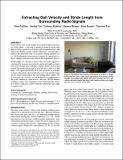
| dc.description.abstract | © 2017 ACM. Gait velocity and stride length are critical health indicators for older adults. A decade of medical research shows that they provide a predictor of future falls, hospitalization, and functional decline among seniors. However, currently these metrics are measured only occasionally during medical visits. Such infrequent measurements hamper the opportunity to detect changes and intervene early in the impairment process. In this paper, we develop a sensor that uses radio signals to continuously measure gait velocity and stride length at home. Our sensor hangs on a wall like a picture frame. It does not require the monitored person to wear or carry a device on her body. Our approach builds on recent advances in wireless systems which have shown that one can locate people based on how their bodies impact the surrounding radio signals. We demonstrate the accuracy of our method by comparing it to the gold standard in clinical tests, and the VICON motion tracking system. Our experience from deploying the sensor in 14 homes indicates comfort with the technology and a high acceptance rate. | en_US |
| dc.language.iso | en | |
| dc.publisher | ACM | en_US |
| dc.relation.isversionof | 10.1145/3025453.3025937 | en_US |
| dc.rights | Creative Commons Attribution-Noncommercial-Share Alike | en_US |
| dc.rights.uri | http://creativecommons.org/licenses/by-nc-sa/4.0/ | en_US |
| dc.source | MIT web domain | en_US |
| dc.title | Extracting Gait Velocity and Stride Length from Surrounding Radio Signals | en_US |
| dc.type | Article | en_US |
| dc.identifier.citation | Hsu, Chen-Yu, Liu, Yuchen, Kabelac, Zachary, Hristov, Rumen, Katabi, Dina et al. 2017. "Extracting Gait Velocity and Stride Length from Surrounding Radio Signals." | |
| dc.contributor.department | Massachusetts Institute of Technology. Computer Science and Artificial Intelligence Laboratory | |
| dc.eprint.version | Author's final manuscript | en_US |
| dc.type.uri | http://purl.org/eprint/type/ConferencePaper | en_US |
| eprint.status | http://purl.org/eprint/status/NonPeerReviewed | en_US |
| dc.date.updated | 2019-06-06T17:56:57Z | |
| dspace.date.submission | 2019-06-06T17:56:59Z | |
| mit.license | OPEN_ACCESS_POLICY | |
| mit.metadata.status | Authority Work and Publication Information Needed | en_US |