

Low-Fidelity vs. High-Fidelity Spatial Design in Virtual Reality for Non-professionals
Download3758871.3758913.pdf (5.561Mb)
Publisher with Creative Commons License
Publisher with Creative Commons License
Creative Commons Attribution
Terms of use
Metadata
Show full item recordAbstract
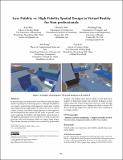
In spatial design, non-professionals lack effective hands-on opportunities to participate in the design process. Although VR platforms can support spatial design with immersive interaction, existing tools simply provide high-fidelity 3D objects for users to choose and place around. Low-fidelity design approach is rarely supported, nor investigated in this context. In this work, we present a user study comparing low-fidelity and high-fidelity spatial design in VR. Eighteen participants were recruited to use both versions of a prototype with varied geometric fidelity to complete home designs. Their design outcome and intent was evaluated by professional designers. Our findings show, the low-fidelity version allowed participants to think more openly and creatively, leading to a more holistic expression of their design intent and needs, while the high-fidelity version promoted users’ thinking of realistic scenarios. We discuss the design implications and how they can be combined in co-design activities.
Description
CHCHI 2024, Shenzhen, China
Date issued
2024-10-29Department
Massachusetts Institute of Technology. Department of ArchitecturePublisher
ACM|The Twelfth International Symposium of Chinese CHI
Citation
Lan Wei, Chenyue Dai, Xuening Peng, Xin Tong, and Can Liu. 2025. Low-Fidelity vs. High-Fidelity Spatial Design in Virtual Reality for Non-professionals. In Proceedings of the Twelfth International Symposium of Chinese CHI (CHCHI '24). Association for Computing Machinery, New York, NY, USA, 486–498.
Version: Final published version
ISBN
979-8-4007-1389-7
Collections
The following license files are associated with this item: